Home
Weather New York
WeatherRadar
RainRadar
TemperatureRadar
WindRadar
LightningRadar
Weather News
Editor's Pick
Discover the app
Weather widget
Contact us
Apps
Career
    Home / Weather News /

    Artemis Launch scrubbed - Taking astronauts to the Moon (& beyond)

09:00 AM
August 29, 2022

Artemis Launch scrubbed
Taking astronauts to the Moon (& beyond)

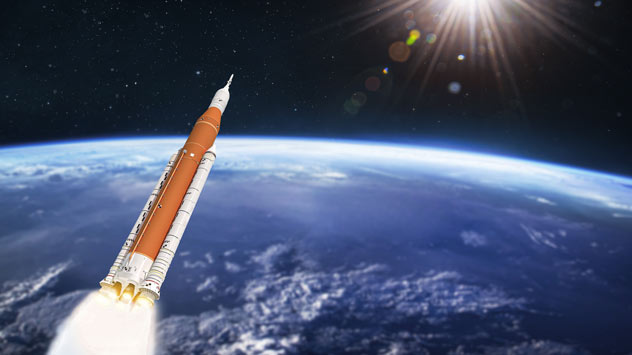
Artemis Program - NASA's Space Launch Systems (SLS) render.

Have you heard about the Artemis Program? In short, this is the program that will take astronauts back to the moon. But there is so much more about this program that hopes to, eventually, takes humans to Mars.

It's Launch Day! The first mission of the Artemis Program is scheduled to launch on August 29 from Cape Canaveral, Florida. The 2-hour launch window opens at 8:33 a.m. So far weather seems to be behaving, but as you know, the weather is only one component of many that must come together to make a successful launch.

WATCH LIVE HERE

NASA’s rocket, the Space Launch System (SLS), which will carry the Orion spacecraft with lots of experiments, microsatellites, and subsequentially the astronauts aboard, is the most powerful rocket in the world.

There are three test flights set. The first test flight is scheduled to launch on August 29 from Florida’s Cape Canaveral. On August 16, the paired SLS rocket and Orion spacecraft rolled out slowly from the Vehicle Assembly Building at Kennedy Space Center and onto the launch pad – very slowly, at 1 mph.

Test flights 2 and 3 will have crews, AKA astronauts.

The second test flight is set to have the spacecraft – and crew – go past the Moon, then come back to Earth. This would mark the first time that humans have been so far from Earth.

The last (number 3) test flight will include the first woman and man to land on the South Pole of the Moon where they will look for the Moon’s water and use it. Astronauts that will be on the Moon will be three 3 days away from Earth. The plan is to have them set up a functional way to live and work outside of Earth so that, when the time comes, they will be able to apply the same findings and ways in missions to Mars. Of course, Mars being a lot farther… 3 years away (round trip)!

This whole project will take a deep dive to closely study our closest natural satellite. SLS will also carry modules and robots that will land in different parts of the Moon and take samples and observations.

Fun fact: In Greek mythology, Artemis is the twin sister of Apollo and the goddess of the Moon. Apollo was the last mission that took astronauts to the Moon.

Irene Sans
More on the topic
High pressure & extreme heat. Why & how does it work?. . . Sunday, July 12, 2026
Sunday, July 12, 2026

Why & how does it work?

High pressure & extreme heat
Rip currents & safety tips. As more head to the coast. . . Saturday, July 25, 2026
rip current
Saturday, July 25, 2026

As more head to the coast

Rip currents & safety tips
Meteorological summer is here!. Bye, spring!. . . Monday, June 1, 2026
Monday, June 1, 2026

Bye, spring!

Meteorological summer is here!
All weather news
This might also interest you
Watch storm clusters interact. A busy WeatherRadar. . . Tuesday, August 11, 2026
Tuesday, August 11, 2026

A busy WeatherRadar

Watch storm clusters interact
Tropical Storm Cristobal and more. Pacific more active. . . Wednesday, August 12, 2026
Wednesday, August 12, 2026

Pacific more active

Tropical Storm Cristobal and more
Heat not felt in 80+ years. Pacific Northwest. . . Tuesday, August 4, 2026
Records as old as 81 and even 124 years could fall this first week of August in the Pacific Northwest as temperatures rise to the 90s & triple digits due to a new heatwave.
Tuesday, August 4, 2026

Pacific Northwest

Heat not felt in 80+ years
All articles
Weather & Radar

Weather & Radar is also available on

Google Play StoreApp Store

Company

Contact us Privacy policy Legal info Accessibility statement

Services

Uploader

Socials

instagramfacebookthreadslinkList