Home
Weather New York
WeatherRadar
RainRadar
TemperatureRadar
WindRadar
LightningRadar
Weather News
Editor's Pick
Discover the app
Weather widget
Contact us
Apps
Career
    Home / Editor's Pick /

    Departed safely: Lightning strikes airplane on take-off

12:00 AM
March 8, 2024

Departed safely
Lightning strikes airplane on take-off

Privacy policy

Video captured last Sunday shows the moment lightning struck an airplane in Canada immediately after take-off, fortunately there were no issues with the flight.

It is the nightmare situation for any nervous flier, last Sunday a Boeing 777 departing Vancouver, Canada experienced a direct lightning strike. Despite this, the flight continued on its journey to London, where it landed safely.

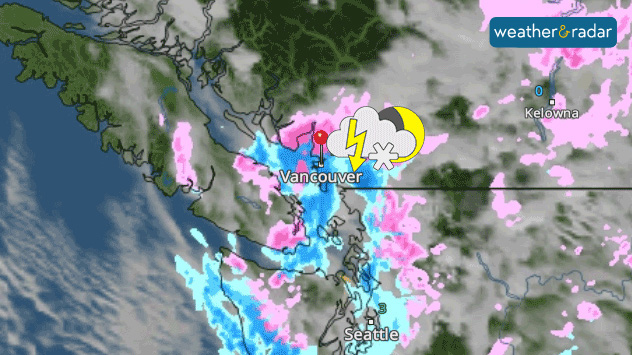
There was heavy rain and snowfall in Vancouver for the departure, sleet may also have been present. The snow and ice crystals in the clouds caused an electrical voltage to build up, which discharged in the form of lightning.

Weather map
The WeatherRadar showed turbulent weather with snow and rain over Vancouver on Sunday. The lightning discharged in a heavy shower.

How safe is an airplane?

A lightning strike on an aircraft can be frightening, but usually has no serious consequences. Aircraft are designed to withstand lightning strikes both in the air and on the ground. Passengers are protected by the so-called Faraday cage.

Did you know?

A Faraday cage is a closed cage made of electrically conductive material that can dissipate lightning, moving the electromagnetic field away from sensitive instruments.

If a strike connects, electricity hits the aircraft, is discharged along the fuselage and leaves the aircraft again. Modern aircraft are also equipped with lightning protection systems to minimize potential damage caused by lightning strikes.

The situation is not as rare as you may imagine. Data from the International Air Transport Association shows most airplanes are struck by lightning once or twice per year.

Strikes hitting an aircraft are most likely when flying in near-freezing temperatures and around 60% occur between March and July.

It is not just lightning from thunderstorms either, many airplanes generate lightning while ascending during take-off, this is known as aircraft induced lightning.

While major damage is very unlikely, any airplane struck by lightning is inspected for damage after landing. Checking for singe marks or paint chips. Engineers work to find the entry, and exit, point of any strike to ensure all is well.

Weather & Radar USA editorial team
More on the topic
Europe: Warmest June on record. Warm waters too. . . Friday, July 10, 2026
The record-breaking heatwave in June has made climate history in Western Europe.
Friday, July 10, 2026

Warm waters too

Europe: Warmest June on record
Record-breaking heatwave in Europe. Hotter than most of U.S.. . . Thursday, June 25, 2026
Thursday, June 25, 2026

Hotter than most of U.S.

Record-breaking heatwave in Europe
Meteorological summer is here!. Bye, spring!. . . Monday, June 1, 2026
Monday, June 1, 2026

Bye, spring!

Meteorological summer is here!
All weather news
This might also interest you
Heat not felt in 80+ years. Pacific Northwest. . . Tuesday, August 4, 2026
Records as old as 81 and even 124 years could fall this first week of August in the Pacific Northwest as temperatures rise to the 90s & triple digits due to a new heatwave.
Tuesday, August 4, 2026

Pacific Northwest

Heat not felt in 80+ years
Big 50-degree jump. Northwest heat extremes. . . Thursday, August 6, 2026
Big temperature jumps
Thursday, August 6, 2026

Northwest heat extremes

Big 50-degree jump
Three common misperceptions. Hurricane season. . . Sunday, August 2, 2026
Hurricane Ian (2022) satellite imagery before SWFL landfall.
Sunday, August 2, 2026

Hurricane season

Three common misperceptions
All articles
Weather & Radar

Weather & Radar is also available on

Google Play StoreApp Store

Company

Contact us Privacy policy Legal info Accessibility statement

Services

Uploader

Socials

instagramfacebookthreadslinkList