Home
Weather New York
WeatherRadar
RainRadar
TemperatureRadar
WindRadar
LightningRadar
Weather News
Editor's Pick
Discover the app
Weather widget
Contact us
Apps
Career
    Home / Editor's Pick /

    Departed safely: Lightning strikes airplane on take-off

12:00 AM
March 8, 2024

Departed safely
Lightning strikes airplane on take-off

Privacy policy

Video captured last Sunday shows the moment lightning struck an airplane in Canada immediately after take-off, fortunately there were no issues with the flight.

It is the nightmare situation for any nervous flier, last Sunday a Boeing 777 departing Vancouver, Canada experienced a direct lightning strike. Despite this, the flight continued on its journey to London, where it landed safely.

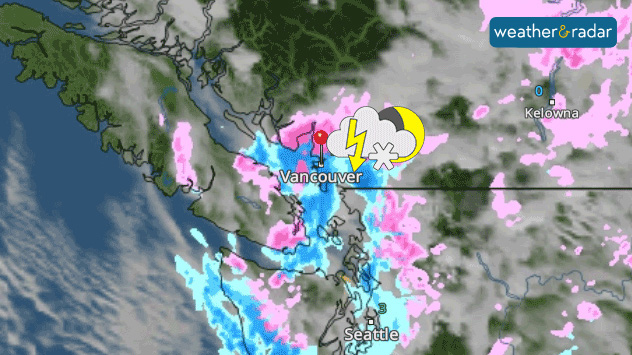
There was heavy rain and snowfall in Vancouver for the departure, sleet may also have been present. The snow and ice crystals in the clouds caused an electrical voltage to build up, which discharged in the form of lightning.

Weather map
The WeatherRadar showed turbulent weather with snow and rain over Vancouver on Sunday. The lightning discharged in a heavy shower.

How safe is an airplane?

A lightning strike on an aircraft can be frightening, but usually has no serious consequences. Aircraft are designed to withstand lightning strikes both in the air and on the ground. Passengers are protected by the so-called Faraday cage.

Did you know?

A Faraday cage is a closed cage made of electrically conductive material that can dissipate lightning, moving the electromagnetic field away from sensitive instruments.

If a strike connects, electricity hits the aircraft, is discharged along the fuselage and leaves the aircraft again. Modern aircraft are also equipped with lightning protection systems to minimize potential damage caused by lightning strikes.

The situation is not as rare as you may imagine. Data from the International Air Transport Association shows most airplanes are struck by lightning once or twice per year.

Strikes hitting an aircraft are most likely when flying in near-freezing temperatures and around 60% occur between March and July.

It is not just lightning from thunderstorms either, many airplanes generate lightning while ascending during take-off, this is known as aircraft induced lightning.

While major damage is very unlikely, any airplane struck by lightning is inspected for damage after landing. Checking for singe marks or paint chips. Engineers work to find the entry, and exit, point of any strike to ensure all is well.

Weather & Radar USA editorial team

More on the topic

Why forecasting snow is so tricky. When will snow fall?. . . Sunday, November 15, 2026
Small snowmen next to a weather map showing snow falling in parts of Scotland.
Sunday, November 15, 2026

When will snow fall?

Why forecasting snow is so tricky
10 facts about fog. Low clouds. . . Sunday, September 27, 2026
Fog impacting the Appalachian Mountains.
Sunday, September 27, 2026

Low clouds

10 facts about fog
The average first frosts in the U.S.. Meteorological autumn. . . Sunday, October 18, 2026
First frosts can begin in September as autumn temps move in.
Sunday, October 18, 2026

Meteorological autumn

The average first frosts in the U.S.
All weather news

This might also interest you

Big West Coast storm. WeatherFeed. . . Friday, November 13, 2026
Friday, November 13, 2026

WeatherFeed

Big West Coast storm
Why is it on November 11?. Veterans Day. . . Wednesday, November 11, 2026
An American soldier
Wednesday, November 11, 2026

Veterans Day

Why is it on November 11?
Last gasp tropical trouble. WeatherFeed. . . Friday, November 20, 2026
Friday, November 20, 2026

WeatherFeed

Last gasp tropical trouble
All articles
Weather & Radar

Weather & Radar is also available on

Google Play StoreApp Store

Company

Contact us Privacy policy Legal info Accessibility statement

Services

Uploader

Socials

instagramfacebookthreadslinkList