Home
Weather New York
WeatherRadar
RainRadar
TemperatureRadar
WindRadar
LightningRadar
Weather News
Editor's Pick
Discover the app
Weather widget
Contact us
Apps
Career
    Home / Editor's Pick /

    Did you know? Seven facts about snow

01:00 PM
December 31, 2023

Did you know?
Seven facts about snow

Mount Rainier
Mount Rainer is visible from Seattle. - © Daniel Schwen, Wikipedia

From myth busters on Earth to findings on Mars, here are seven facts you may not know about snow.

1. The snowiest place in the U.S.

It will be no surprise to anyone, but the snowiest places sits on a mountain — technically a volcano. Washington's Mount Rainier averages 645.5 inches of snow per year. Rainier is about 59 miles south-southeast Seattle and is visible from the Emerald City on clear day.

2. Deepest snow?

The deepest snow ever recorded in the U.S. was in Tamarack, Calif., in 1911. The snow depth was 451 inches or 37.5 feet. This is located in the Sierra Nevada.

3. Snow isn't white

It's actually totally clear! Although snowflakes appear white, ice is translucent, meaning light only passes through indirectly, so diffuse reflection through the many sides of the ice crystals causes it to seem white in color.

4. How fast?

Snow falls at an average speed of 1 to 4 mph, taking around an hour to reach the ground. If any snowflakes become supercooled, and heavier, they can fall a little faster than your regular snowflake.

5. It's never too cold to snow!

It can never be too cold, but it can be too dry!

6. Snow on Mars

According to NASA, during the summer in the north of the planet there could be violent snow storms. With clouds and subsurface ice detected on Mars, snow is certainly plausible.

Scientists also found a cloud of carbon dioxide snowflakes over the southern pole of Mars.

7. Dust must be present

The cold water droplet needs to have dust or pollen particles to freeze onto in the sky to create an ice crystal.

Weather & Radar USA editorial team

More on the topic

Why do leaves change color in autumn?. The transformation begins. . . Saturday, October 17, 2026
Autumn leaves
Saturday, October 17, 2026

The transformation begins

Why do leaves change color in autumn?
The average first frosts in the U.S.. Meteorological autumn. . . Sunday, October 18, 2026
First frosts can begin in September as autumn temps move in.
Sunday, October 18, 2026

Meteorological autumn

The average first frosts in the U.S.
Polar night is upon us. Northern Alaska. . . Sunday, November 22, 2026
Sunday, November 22, 2026

Northern Alaska

Polar night is upon us
All weather news

This might also interest you

Southern autumn storm heads north. WeatherFeed. . . Wednesday, November 25, 2026
Wednesday, November 25, 2026

WeatherFeed

Southern autumn storm heads north
Lake-effect snow explained. What is it?. . . Sunday, November 15, 2026
Sunday, November 15, 2026

What is it?

Lake-effect snow explained
The different winter precipitation types. Snow, sleet, graupel.... . . Saturday, November 14, 2026
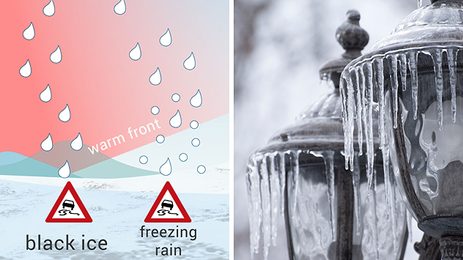
Split image of freezing rain turned to ice over street lamps and infographic describing the different precipitation types.
Saturday, November 14, 2026

Snow, sleet, graupel...

The different winter precipitation types
All articles
Weather & Radar

Weather & Radar is also available on

Google Play StoreApp Store

Company

Contact us Privacy policy Legal info Accessibility statement

Services

Uploader

Socials

instagramfacebookthreadslinkList