Home
Weather New York
WeatherRadar
RainRadar
TemperatureRadar
WindRadar
LightningRadar
Weather News
Editor's Pick
Discover the app
Weather widget
Contact us
Apps
Career
Home / Editor's Pick /

Five times faster: Greenland's unprecedented glacier melt

02:00 PM
November 18, 2023

Five times faster
Greenland's unprecedented glacier melt

Seaplane over the Stauning Alps in East Greenland, 1933.Seaplane over the Stauning Alps in East Greenland, 1933. - © Danish Agency for Data Supply and Infrastructure

The glaciers in Greenland are melting five times faster than they did before the millennium.

This is the conclusion of a comprehensive study from the University of Copenhagen, published in the leading scientific journal Nature Climate Change.

The study shows that the glaciers along the coast of Greenland are melting 25 meters per year today, while it was around five meters per year in the 1980s and 1990s. The researchers refer to this as a "new, accelerated state of degradation". In other words, the rate of melting is unprecedented.

Until now, it has been quite difficult to get an accurate picture of the extent of the melting up to 130 years ago, as the technological tools of today were not available.

However, researchers have used aerial photos and satellite images from the Danish National Archives dating back to the 1930s, when Denmark began to thoroughly document the coast of Greenland in order to create maps. This archive has never been used before and provides a unique insight.

Out of Greenland's 22,000 glaciers, researchers have manually scrutinized over 1,000 of them using 200,000 old photos. This is the largest ever mapping based on such sources.

Anders Bjørk, Assistant Professor at the Department of Geosciences and Natural Resource Management and one of the researchers behind the article says the following: "Just over 1,000 glaciers is a huge number to study, but we did it because we simply wanted to make sure we had a complete picture of the development over the last 130 years."

The new knowledge generated by this study has two important functions. Firstly, the documentation itself. The researchers can now state with great certainty that the glaciers are in a new phase, where even the northernmost glaciers along the coast are melting extremely fast.

In addition, the documentation will have an important job as data for climate models that project what will happen, for example, to sea levels in the future as the glaciers melt and become part of the oceans. Such models become better and more accurate the better the documentation that forms the basis of the calculations.

Weather & Radar USA editorial team
More on the topic
A graphic for World Meteorological Day featuring weather symbols.
Monday, March 23, 2026

World Meteorological Day

Monitor today, protect tomorrow
Saturday, March 14, 2026

Risks & preparedness

All about nocturnal severe weather
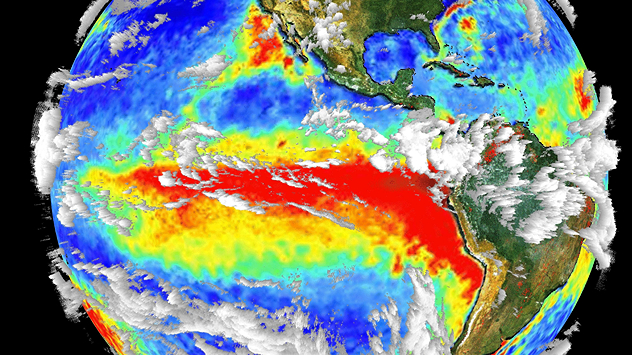
The image shows the central Pacific in a computer model. A striking feature is the ocean coloured red, which indicates very warm seawater.
Tuesday, March 24, 2026

Global consequences

El Niño is back
All weather news
This might also interest you
Sunscreen
Sunday, April 5, 2026

Strong April Sunshine!!

A spring sunburn?
Thursday, April 2, 2026

Central U.S.

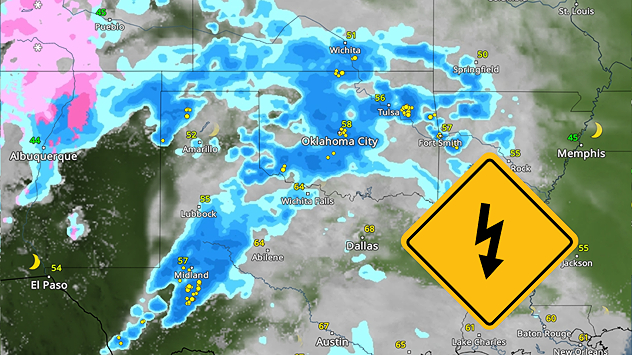
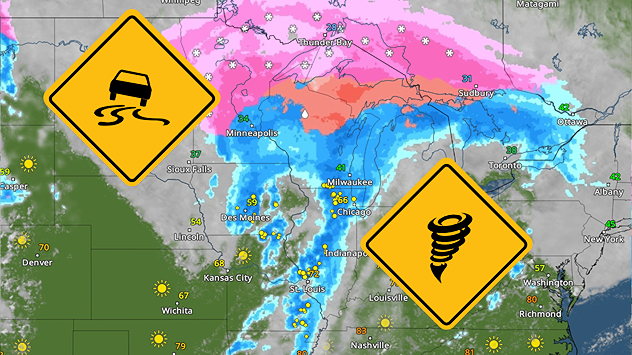
Storm triggers wintry mix, severe weather
Tuesday, March 31, 2026

Northeast U.S.

Heavy rain poses flash flood risk
All articles
Weather & Radar

Weather & Radar is also available on

Google Play StoreApp Store

Company

Contact us Privacy policy Legal info Accessibility statement

Services

Uploader

Socials

instagramfacebookthreadslinkList