Home
Weather New York
WeatherRadar
RainRadar
TemperatureRadar
WindRadar
LightningRadar
Weather News
Editor's Pick
Discover the app
Weather widget
Contact us
Apps
Career
Home / Editor's Pick /

Icy beauty - The science behind rime ice

08:00 PM
January 4, 2026

Icy beauty
The science behind rime ice

Once winter's chill settles in, rime ice can form due to low clouds or fog, especially in high elevations. All you need are surface temperatures below freezing. So how does it work?

Rime ice is a type of frozen precipitation that forms when supercooled liquid droplets freeze onto surfaces. The droplets usually come from fog or low-lying clouds, and they freeze instantly upon contact with a surface that is at or below freezing temperature. Have you seen any freezing temperatures on our TemperatureRadar?

1/2
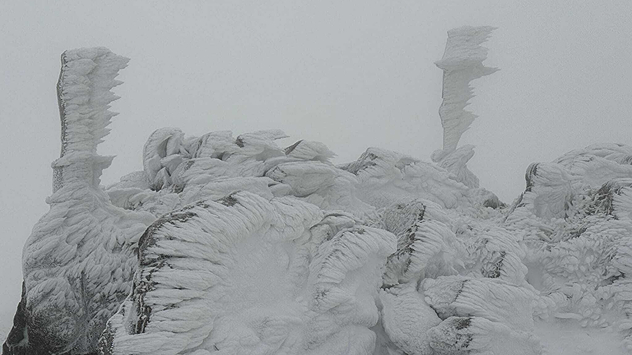
Rime ice on top of Mount Reixa in northern Italy on December 10, 2024. Images by Andrea Ferrando.

When the ice forms, it can look fuzzy or feathery, just like it did in Italy's Ligurian Apennines on Monte Reixa in mid-December 2024. Closer to home, Mount Washington in New Hampshire often sees this weather phenomenon due to the mountain's elevation of over 6,000 feet and, therefore, very cold temperatures at the mountaintop.

The feathery, fuzzy texture of rime ice is caused by the way the supercooled droplets freeze. As the droplets freeze, they release heat, which causes the surrounding air to expand rapidly. This expansion causes the droplets to break apart and form a mist, which then freezes to form feathery crystals of rime ice.

Did you know?

Use the handy Weather & Radar app to know when you could experience freezing fog - hopefully from the comfort of your own home. Surface temperatures, like on your car, have to be at or below freezing. For fog to form, we want the dewpoint as close to the outside temperature as possible. Find the dewpoint information in your hourly forecast at the top of the app!

You can look for the wintertime fog or low clouds on the WeatherRadar. They show up rather thick on the satellite and can often be a problem for air travel when the aircraft surface is at or below freezing. Remember the last time you had to wait for the air traffic crew to de-ice the plane? Now you know part of why they're taking these precautions!

Mary Mays
More on the topic
Monday, February 2, 2026

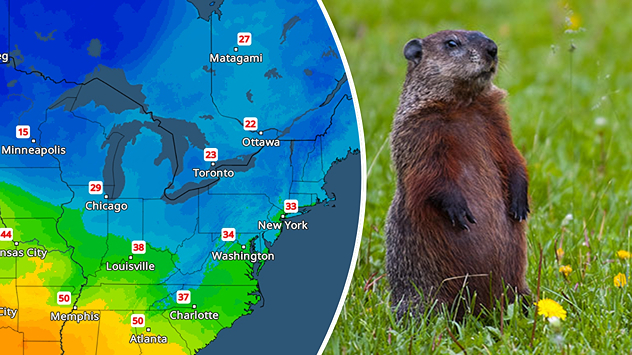
Phil said it himself

Six more weeks of winter
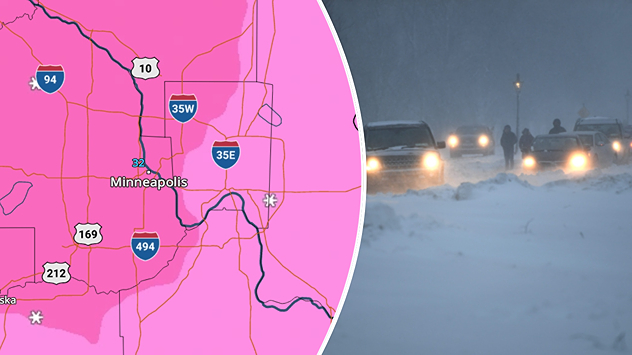
Winter weather impacts Minneapolis.
Saturday, January 3, 2026

Build your emergency kit

Stuck in a snow storm survival kit
pothole repair
Sunday, February 8, 2026

Bumpy commute

Cold = potholes
All weather news
This might also interest you
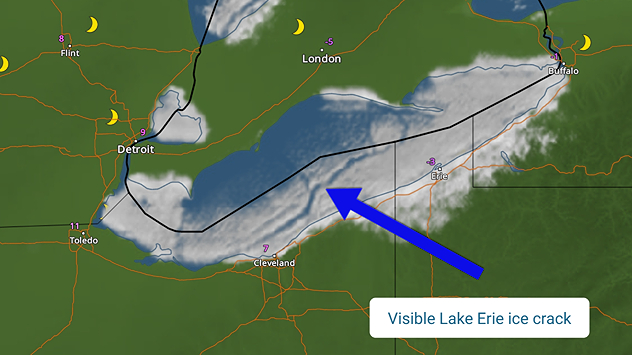
Great Lakes ice crack teaser.
Monday, February 9, 2026

Lake Erie locked in ice

Ice crack visible from space
Tuesday, February 10, 2026

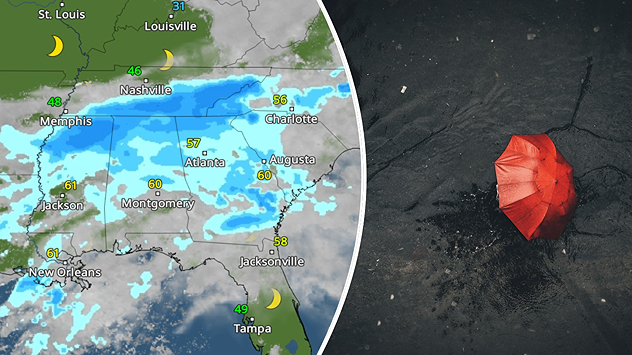
Cooler temps too

Wet system hits the South
Thursday, February 5, 2026

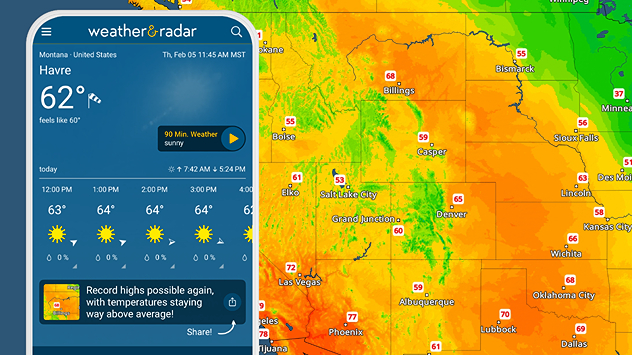
A warm winter's day

Record highs for the western half
All articles
Weather & Radar
US
Clima & Radar Brasil
Hava durumu & Radar Türkiye
Időjárás és Radar Magyarország
Καιρός & Ραντάρ Ελλάδα
Météo & Radar Belgique (Français)
Météo & Radar France
Meteo & Radar Italia
Meteo & Radar România
Météo & Radar Suisse (Français)
Meteo & Radars Latvija
OrasOnline Lietuva
Počasí & Radar Czechia
Počasie & Radar Slovensko
Pogoda & Radar Polska
Погода & Радар Україна (українська)
Tempo & Radar Portugal
Tiempo & Radar Argentina
Tiempo & Radar España
Vejr & Radar Danmark
Vreme & Radar Slovenija
Vreme & Radar Srbija
Vrijeme & Radar Bosna
Vrijeme & Radar Crna Gora
Vrijeme & Radar Hrvatska
Време & Радар България
Времето & Радар Macedonia
Weather & Radar India (English)
Weather & Radar Ireland
Weather & Radar United Kingdom
Weather & Radar USA (Español)
Weer & Radar België (Nederlands)
Weer & Radar Nederland

Weather & Radar is also available on

Google Play StoreApp Store

Company

Contact us Privacy policy Legal info Accessibility statement

Services

Uploader

Socials

instagramfacebookthreadslinkList