Home
Weather New York
WeatherRadar
RainRadar
TemperatureRadar
WindRadar
LightningRadar
Weather News
Editor's Pick
Discover the app
Weather widget
Contact us
Apps
Career
    Home / Editor's Pick /

    Icy beauty - The science behind rime ice

08:00 PM
January 4, 2026

Icy beauty
The science behind rime ice

Once winter's chill settles in, rime ice can form due to low clouds or fog, especially in high elevations. All you need are surface temperatures below freezing. So how does it work?

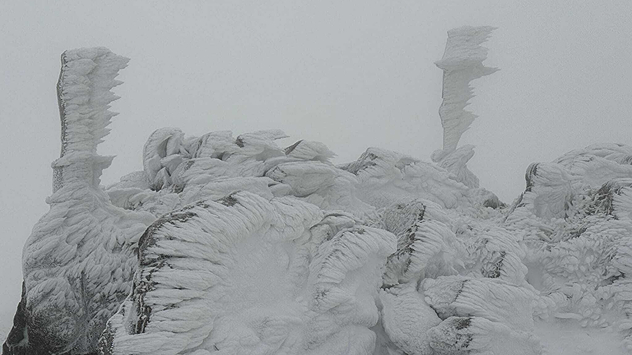
Rime ice is a type of frozen precipitation that forms when supercooled liquid droplets freeze onto surfaces. The droplets usually come from fog or low-lying clouds, and they freeze instantly upon contact with a surface that is at or below freezing temperature. Have you seen any freezing temperatures on our TemperatureRadar?

1/2
Rime ice on top of Mount Reixa in northern Italy on December 10, 2024. Images by Andrea Ferrando.

When the ice forms, it can look fuzzy or feathery, just like it did in Italy's Ligurian Apennines on Monte Reixa in mid-December 2024. Closer to home, Mount Washington in New Hampshire often sees this weather phenomenon due to the mountain's elevation of over 6,000 feet and, therefore, very cold temperatures at the mountaintop.

The feathery, fuzzy texture of rime ice is caused by the way the supercooled droplets freeze. As the droplets freeze, they release heat, which causes the surrounding air to expand rapidly. This expansion causes the droplets to break apart and form a mist, which then freezes to form feathery crystals of rime ice.

Did you know?

Use the handy Weather & Radar app to know when you could experience freezing fog - hopefully from the comfort of your own home. Surface temperatures, like on your car, have to be at or below freezing. For fog to form, we want the dewpoint as close to the outside temperature as possible. Find the dewpoint information in your hourly forecast at the top of the app!

You can look for the wintertime fog or low clouds on the WeatherRadar. They show up rather thick on the satellite and can often be a problem for air travel when the aircraft surface is at or below freezing. Remember the last time you had to wait for the air traffic crew to de-ice the plane? Now you know part of why they're taking these precautions!

Mary Mays
More on the topic
Rip currents & safety tips. As more head to the coast. . . Saturday, July 25, 2026
rip current
Saturday, July 25, 2026

As more head to the coast

Rip currents & safety tips
Waterspouts possible, what are they?. They can be dangerous. . . Saturday, July 11, 2026
Waterspouts weatherradar.
Saturday, July 11, 2026

They can be dangerous

Waterspouts possible, what are they?
Longest day of the year is here. Summer solstice. . . Sunday, June 21, 2026
Sunday, June 21, 2026

Summer solstice

Longest day of the year is here
All weather news
This might also interest you
Gulf system is becoming better organized. It moves slowly. . . Monday, July 20, 2026
Monday, July 20, 2026

It moves slowly

Gulf system is becoming better organized
Multi-Day flood threat for Mid-Atlantic. Stalled front. . . Wednesday, July 22, 2026
Wednesday, July 22, 2026

Stalled front

Multi-Day flood threat for Mid-Atlantic
Lopsided Bertha moves west. Who sees the impacts. . . Thursday, July 23, 2026
Thursday, July 23, 2026

Who sees the impacts

Lopsided Bertha moves west
All articles
Weather & Radar

Weather & Radar is also available on

Google Play StoreApp Store

Company

Contact us Privacy policy Legal info Accessibility statement

Services

Uploader

Socials

instagramfacebookthreadslinkList