Home
Weather New York
WeatherRadar
RainRadar
TemperatureRadar
WindRadar
LightningRadar
Weather News
Editor's Pick
Discover the app
Weather widget
Contact us
Apps
Career
Home / Editor's Pick /

Land loss is a major issue: Sand storms are getting stronger and more frequent

Land loss a major issue
Sand storms are getting stronger

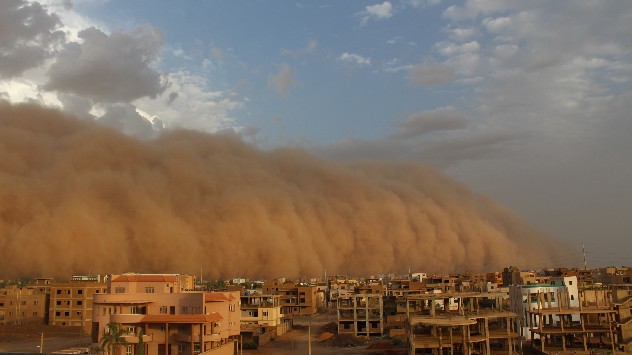
Sandstorm looms over cityRolling waves of sand and dust reach Khartoum, Sudan, an increasingly common sight.

Sand and dust storms are causing devastating land loss and other consequences as this atmospheric phenomenon becomes “dramatically” stronger and more frequent.

A report published by the United Nations revealed that two billion tons of sand and dust enter the atmosphere each year. A weight equivalent to 350 Great Pyramids of Giza.

The costly phenomenon particularly impacts northern and central Asia and sub-Saharan Africa, with poorly understood health impacts.

These storms are a natural occurrence, increasing during drier seasons as sand and dust accumulate. However, the frequency is rising due to poor land and water management, drought, and climate change, according to experts from the United Nations Convention to Combat Desertification (UNCCD).

The body suggests that over 25 percent of the problem is a result of human activities, with the shifting sand causing more than one million square kilometers of workable land to be lost annually.

In areas where the dust is lofted by winds, crops, livestock, and topsoil are negatively affected. As the dust travels, it enters the atmosphere and reaches areas with already poor air quality worsening respiratory diseases.

Some countries are already taking steps to protect against such storms. This includes the Great Green Wall in China, a project to plant a wall of trees designed to capture sand and dust from the Gobi Desert before it reaches major cities and halts the desert's expansion.

In the U.S., we are most often impacted by dust from the Saharan Desert, especially across Florida, which can travel west in the Trade Winds and result in vibrant sunrises and sunsets.

Weather & Radar USA editorial team
This might also interest you
Saturday, January 31, 2026

Gusts topping 75 mph

Winter storm to intensify Saturday
Split image showing the TemperatureRadar on the left and a man in cold weather on the right.
Saturday, January 31, 2026

Advanced cold measurement

Understanding the feels like temperature
Wintry weather impacts D.C. on the WeatherRadar.
Sunday, February 1, 2026

Snow, sleet or ice

How atmospheric temps shape winter precipitation
All articles
Weather & Radar
US
Clima & Radar Brasil
Hava durumu & Radar Türkiye
Időjárás és Radar Magyarország
Καιρός & Ραντάρ Ελλάδα
Météo & Radar Belgique (Français)
Météo & Radar France
Meteo & Radar Italia
Meteo & Radar România
Météo & Radar Suisse (Français)
Meteo & Radars Latvija
OrasOnline Lietuva
Počasí & Radar Czechia
Počasie & Radar Slovensko
Pogoda & Radar Polska
Погода & Радар Україна (українська)
Tempo & Radar Portugal
Tiempo & Radar Argentina
Tiempo & Radar España
Vejr & Radar Danmark
Vreme & Radar Slovenija
Vreme & Radar Srbija
Vrijeme & Radar Bosna
Vrijeme & Radar Crna Gora
Vrijeme & Radar Hrvatska
Време & Радар България
Времето & Радар Macedonia
Weather & Radar India (English)
Weather & Radar Ireland
Weather & Radar United Kingdom
Weather & Radar USA (Español)
Weer & Radar België (Nederlands)
Weer & Radar Nederland

Weather & Radar is also available on

Google Play StoreApp Store

Company

Contact us Privacy policy Legal info Accessibility statement

Services

Uploader

Socials

instagramfacebookthreadslinkList