Home
Weather New York
WeatherRadar
RainRadar
TemperatureRadar
WindRadar
LightningRadar
Weather News
Editor's Pick
Discover the app
Weather widget
Contact us
Apps
Career
    Home / Editor's Pick /

    Spectacular auroras: 1st extreme geomagnetic storm since 2003

05:00 PM
May 13, 2024

Spectacular auroras
1st extreme geomagnetic storm since 2003

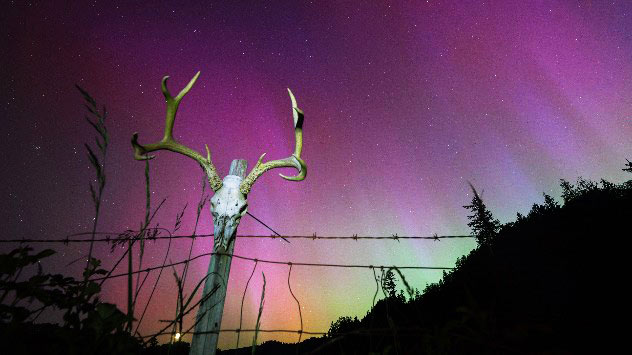
Elkton, Oregon, USA: The aurora borealis,
May 12, 2024, Crater Lake National Park, Oregon, USA:
 San Rafael, California, United States on May 11, 2024. picture alliance / Anadolu | Tayfun Coskun
Picture alliance / ZUMAPRESS.com | Daniel Carde
1/4
May 11, 2024, Elkton, Oregon, USA: The aurora borealis, also known as the northern lights, glow in the sky over a farm pasture near Elkton in southwestern Oregon. (Credit Image: © Robin Loznak/ZUMA Press Wire - © © Robin Loznak/ZUMA Press Wire

Did you see the northern lights this weekend? We witnessed the most extreme geomagnetic storm since 2003.

The morning of Saturday 11th May experienced the 27th strongest solar flare since measurements of the sun began.

This meant that when the coronal mass ejections (CME) collided with the Earth's magnetic field, the charged particles interacted with the gases in our atmosphere, producing the colorful aurora.

There were an unusual array of colors spotted dancing in the sky, up and down in places as far south as Key Largo, Florida, as seen in the selection of photos that were sent into our dedicated uploader. The more common green color indicates a higher concentration of oxygen at lower altitudes, while pinks and purples at higher altitudes were also visible, indicating a greater presence of nitrogen at higher altitudes, but lower oxygen.

Not only did the sun's enhanced activity allow us to see the northern lights, but we very much have the weather to thank for that too. If it weren't for clear skies between 10 pm and 2 am, we wouldn't have stood a chance. The image above from our WeatherRadar shows how much of the United States was cloud-free.

Aurora is best spotted away from light pollution, and the moon was also in our favor as it was in its Waxing Crescent phase, only about 15% illuminated.

Multiple days of risk from TX to FLread more

If you missed out on the sights, do not worry, with activity set to peak into summer 2025, hopefully, there will be more opportunities.

Check out some more pictures seen in the United Kingdom below!

Weather & Radar USA editorial team
More on the topic
A young woman is kneeling in a cornfield, tending to her plants
Sunday, April 26, 2026

WMO report

Heat is affecting agriculture globally
Saturday, April 18, 2026

Risks & preparedness

All about nocturnal severe weather
Saturday, May 2, 2026

May astronomy outlook

The only Blue Moon of the year rises
All weather news
This might also interest you
Rain soaked much of the South over the holiday weekend, and the unsettled weather continues through the rest of the week. Flash flooding is a concern as heavy rain falls in already saturated areas.
Tuesday, May 26, 2026

Downpours continue

Flood threat targets South
Heavy rain across Florida
Wednesday, May 27, 2026

Drought relief

Heavy rain hits Sunshine State
Thursday, May 28, 2026

From wet to sunny

WindRadar: Southwest to northerly flow
All articles
Weather & Radar

Weather & Radar is also available on

Google Play StoreApp Store

Company

Contact us Privacy policy Legal info Accessibility statement

Services

Uploader

Socials

instagramfacebookthreadslinkList