Home
Weather New York
WeatherRadar
RainRadar
TemperatureRadar
WindRadar
LightningRadar
Weather News
Editor's Pick
Discover the app
Weather widget
Contact us
Apps
Career
    Home / Editor's Pick /

    The deadliest: How to stay safe from storm surge

07:30 PM
September 27, 2025

The deadliest threat
How to stay safe from storm surge

With any landfalling tropical storms or hurricanes, one of the threats will be storm surge. Do you know how to stay safe when it threatens your area?

What is storm surge?

Storm surge is an abnormal rise of ocean water generated by an approaching low-pressure system, often a hurricane. As the storm nears the coast, water is pushed onshore by its strong winds. The inundation causing storm surge, which could be several feet high, is measured above the local astronomical tide.

Several factors can make a storm surge more susceptible than others. One of these is, of course, storm intensity. Stronger storms have higher winds that can exert more force over the ocean, pushing more water inland.

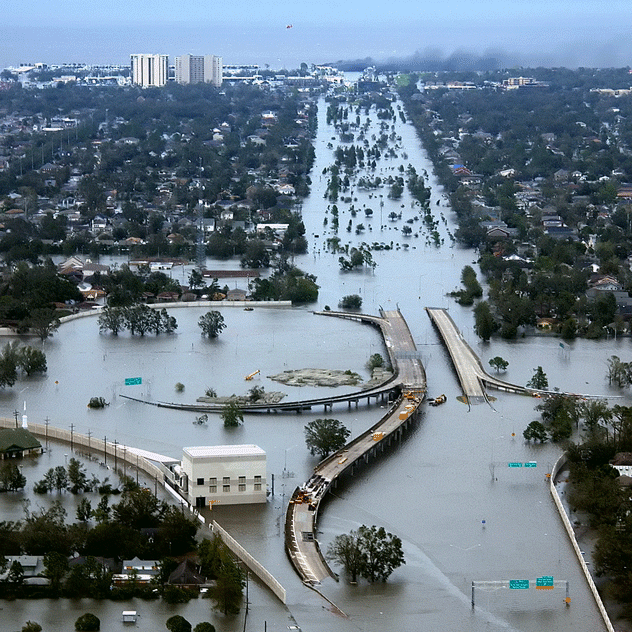
katrina

Another factor is bathymetry and the continental shelf. The shape and slope of the ocean bottom can have a significant effect on storm surge. For example, water that is pushed towards the coast can ride inland more easily over a shallow slope than over a steep one.

Run from the water, hide from the wind

Other factors that can influence storm surge are a storm's forward speed, angle of approach to the coast, central pressure, and the shape and characteristics of coastal features such as bays and estuaries.

Forecasting storm surge

With so many moving parts, it can become quite challenging to pinpoint precisely how much storm surge an area may experience in the event of a hurricane or strong low-pressure system.

Meteorologists at the National Hurricane Center use the Sea Lake and Overland Surge from Hurricanes (SLOSH) model, which considers all the factors mentioned above to predict how much inundation an area may experience.

Staying safe from storm surge

The best way to prepare for storm surge is to understand your risk. If you are near the coast or in a low-lying area, you are more likely to be at risk of storm surge and should closely monitor the progress of storms. If you are in an evacuation zone and prompted to leave, it is a good idea to heed and follow guidance from your local authorities.

Remember, storm surge is just one piece of the puzzle. Heavy rain can make inundation in your area worse, while battering waves above the surge may increase damage to buildings directly along the coast.

Irene Sans

More on the topic

Why forecasting snow is so tricky. When will snow fall?. . . Sunday, November 15, 2026
Small snowmen next to a weather map showing snow falling in parts of Scotland.
Sunday, November 15, 2026

When will snow fall?

Why forecasting snow is so tricky
The average first frosts in the U.S.. Meteorological autumn. . . Sunday, October 18, 2026
First frosts can begin in September as autumn temps move in.
Sunday, October 18, 2026

Meteorological autumn

The average first frosts in the U.S.
What are weather fronts?. Weather explained. . . Saturday, October 24, 2026
Image of a temperature radar showing a clear distinction between a warm and cold air mass separated by a cold front.
Saturday, October 24, 2026

Weather explained

What are weather fronts?
All weather news

This might also interest you

Southern autumn storm heads north. WeatherFeed. . . Wednesday, November 25, 2026
Wednesday, November 25, 2026

WeatherFeed

Southern autumn storm heads north
Potent Thanksgiving storm. WeatherFeed. . . Thursday, November 26, 2026
Thursday, November 26, 2026

WeatherFeed

Potent Thanksgiving storm
Preparing your garden for winter. Colder months ahead. . . Sunday, November 8, 2026
Sunday, November 8, 2026

Colder months ahead

Preparing your garden for winter
All articles
Weather & Radar

Weather & Radar is also available on

Google Play StoreApp Store

Company

Contact us Privacy policy Legal info Accessibility statement

Services

Uploader

Socials

instagramfacebookthreadslinkList