Home
Weather New York
WeatherRadar
RainRadar
TemperatureRadar
WindRadar
LightningRadar
Weather News
Editor's Pick
Discover the app
Weather widget
Contact us
Apps
Career
    Home / Weather News /

    Why some sunsets are beautiful and others are duds

07:00 PM
July 26, 2025

And why are some duds?
Why are some sunsets so beautiful?

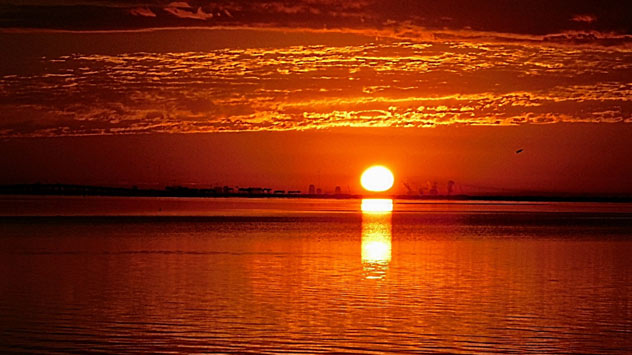
Have you ever seen a sunset so beautiful that it took your breath away? On the other hand, have you ever traveled to a scenic location and been less than wowed by the sunset? Let's talk about what makes a sunset beautiful and what makes it a dud.

There's a lot of lore when it comes to the weather and the sky's appearance as the sun sets. The saying “red skies at night sailors delight; red skies in the morning sailors take warning” is famous as a weather prediction tool and there is some science to back it up. But why are some sunsets vibrant and others muted?

Red skies at night a sailor's delight?read more

First, let's talk about what a beautiful sunset is. Generally, we consider colorful sunsets to be more beautiful than washed-out ones. Hues of red, pink, and orange can streak across the sky as the sun sets, creating a vibrant scene. That's not to say that less colorful sunsets aren't pretty, but usually, the more colorful a sunset is, the better.

Second, what makes the sky burst with colors during the sunset? Scattering. The colors we see, or don't see, are a result of light being scattered as it hits the particles in our atmosphere. The colors we see are determined by the different wavelengths of light and the size of the particles in the atmosphere.

Honorable Mention

Visible light contains all of the colors of the rainbow: red, orange, yellow, green, blue, indigo, and violet. At sunrise and sunset, sunlight passes through more air in the atmosphere compared to what it passes through when the sun is high in the sky. The more atmosphere light travels through, the more particles there will be to scatter the sunlight.

When the sky is the bright red we love to see in sunsets, it's an indication the atmosphere is full of moisture and dust particles. We see the red color because it has the longest wavelength in the spectrum. The shorter wavelengths, such as blue, aren't visible because they are broken up by the particles in the atmosphere. The longer wavelengths, such as red and orange, are able to travel to our eyes, and thus the sunset is vibrant and beautiful.

Clouds also play a significant role in the beauty of a sunset, but their height matters. Clouds reflect the sun's rays back to the ground, creating a vivid sky. High and mid-level clouds, like altocumulus and cirrus clouds, often provide the most stunning sunsets. Low-level clouds, on the other hand, can lead to a more muted array of colors.

How to send us a photoread more

If you manage to catch a picture of a stunning sunset, we want to see it! Send your sunset, sunrise, and any other stunning weather pictures to Weather & Radar.

Mary Mays

More on the topic

Lowest temperature is just after sunrise. Coldest time of the day. . . Sunday, October 18, 2026
setting-sun
Sunday, October 18, 2026

Coldest time of the day

Lowest temperature is just after sunrise
10 facts about fog. Low clouds. . . Sunday, September 27, 2026
Fog impacting the Appalachian Mountains.
Sunday, September 27, 2026

Low clouds

10 facts about fog
The average first frosts in the U.S.. Meteorological autumn. . . Sunday, October 18, 2026
First frosts can begin in September as autumn temps move in.
Sunday, October 18, 2026

Meteorological autumn

The average first frosts in the U.S.
All weather news

This might also interest you

145-year-old record could be tied. Late-season heatwave. . . Wednesday, October 14, 2026
Wednesday, October 14, 2026

Late-season heatwave

145-year-old record could be tied
Rare tornado risk accompanies flood risk. Autumn tropical influx. . . Wednesday, October 21, 2026
Southwest rainfall
Wednesday, October 21, 2026

Autumn tropical influx

Rare tornado risk accompanies flood risk
Moisture from Simon supercharges rain. Central US. . . Wednesday, October 14, 2026
Tropical moisture from Pacific Hurricane Simon is supercharging rainfall totals across portions of the central and southern Plains. Record-high moisture levels are being observed due to this setup.
Wednesday, October 14, 2026

Central US

Moisture from Simon supercharges rain
All articles
Weather & Radar

Weather & Radar is also available on

Google Play StoreApp Store

Company

Contact us Privacy policy Legal info Accessibility statement

Services

Uploader

Socials

instagramfacebookthreadslinkList