Home
Weather New York
WeatherRadar
RainRadar
TemperatureRadar
WindRadar
LightningRadar
Weather News
Editor's Pick
Discover the app
Weather widget
Contact us
Apps
Career
    Home / Weather News /

    How to watch the total lunar eclipse

08:46 PM
March 2, 2026

Set your alarms!
How to watch the total lunar eclipse

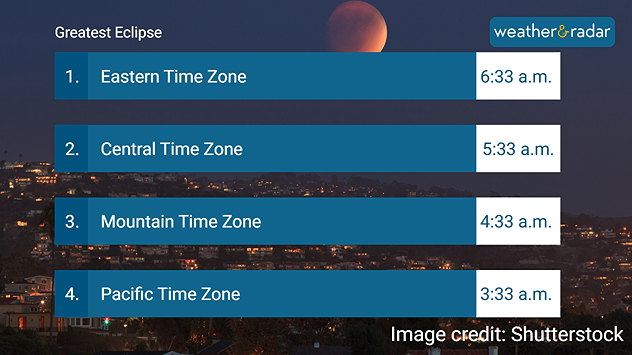
The midpoint of totality — the Moon is deepest in Earth’s shadow and often most richly colored.

Early tomorrow morning, skywatchers across the country will be treated to a total lunar eclipse, often called a “blood moon.”

During a total lunar eclipse, the Earth moves directly between the Sun and the Moon, casting its shadow across the lunar surface. As the Moon passes fully into Earth’s shadow, it will take on a deep reddish or coppery glow. Tomorrow morning's eclipse will be the last one visible for the lower 48 until 2029.

You will start to see a shift in the moon's color during the totality. Totality begins when the Moon is completely inside Earth’s inner shadow, turning a deep red or copper color. This phase starts at approximately 3:04 a.m. PST, 4:04 a.m. MST, 5:04 a.m. CST, and 6:04 a.m. EST.

The greatest eclipse follows at 3:33 a.m. PST, 4:33 a.m. MST, 5:33 a.m. CST, and 6:33 a.m. EST, marking the midpoint of totality when the Moon is deepest in Earth’s shadow and often displays its richest color. Totality ends at about 4:03 a.m. PST, 5:03 a.m. MST, 6:03 a.m. CST, and 7:03 a.m. EST, as the Moon begins to exit Earth’s umbra and the red hue gradually fades.

Check the WeatherRadar for sky conditions before heading out. Also, you'll want to check sunrise and moonset times using our astro function, especially if you are on the East Coast. East Coast cities may be treated to a rare sight called a selenelion, where you'll briefly be able to see the sun rising and the totally eclipsed moon setting on opposite horizons.

Mary Mays
More on the topic
Meteorological vs astronomical autumn. Season start date. . . Tuesday, September 1, 2026
Tuesday, September 1, 2026

Season start date

Meteorological vs astronomical autumn
The average first frosts in the U.S.. Meteorological autumn. . . Sunday, October 4, 2026
First frosts can begin in September as autumn temps move in.
Sunday, October 4, 2026

Meteorological autumn

The average first frosts in the U.S.
Hurricane Polo heads for Mexico. Severe weather risk. . . Monday, September 28, 2026
Hurricane Polo is set to make landfall in the Baja-California.
Monday, September 28, 2026

Severe weather risk

Hurricane Polo heads for Mexico
All weather news
This might also interest you
Isaias landfall dangers. Surge, outages, flooding. . . Friday, October 9, 2026
Friday, October 9, 2026

Surge, outages, flooding

Isaias landfall dangers
First tropical storm since the 90s?. Southern California. . . Friday, October 9, 2026
Friday, October 9, 2026

Southern California

First tropical storm since the 90s?
October's rain doubled in just days. Flooding possible. . . Tuesday, October 13, 2026
Tuesday, October 13, 2026

Flooding possible

October's rain doubled in just days
All articles
Weather & Radar

Weather & Radar is also available on

Google Play StoreApp Store

Company

Contact us Privacy policy Legal info Accessibility statement

Services

Uploader

Socials

instagramfacebookthreadslinkList