Home
Weather New York
WeatherRadar
RainRadar
TemperatureRadar
WindRadar
LightningRadar
Weather News
Editor's Pick
Discover the app
Weather widget
Contact us
Apps
Career
    Home / Editor's Pick /

    More severe weather this week: Timing & areas at most risk

03:10 PM
April 29, 2024

More severe weather
Timing & areas at most risk

The weather starts relatively calm this week, but things start to ramp up through the middle of the week with another slow-moving storm coming out of the Rockies. Let’s dive into the forecast.

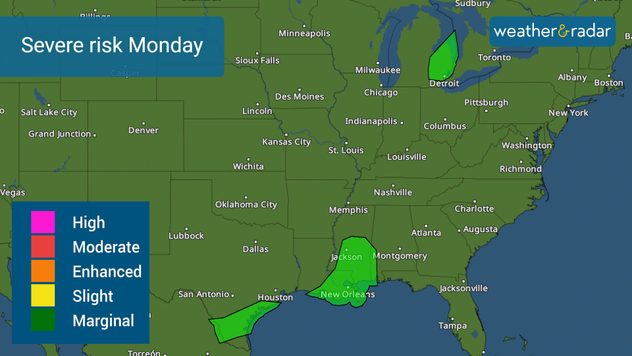
On Monday, the front associated with the system that created devastation over the Central Plains, flattening towns in Oklahoma on Saturday night will drape over the Gulf Coast and continue to meander nearby. It will increase the risk of downpours and some strong storms that could cause flooding from southern Texas to the western part of the Florida Panhandle. Corpus Christi through the upper Rio Grande Valley and the Central north Gulf coast, including New Orleans, have the most potential for some scattered strong storms.

Scattered strong to severe storms across parts of the Gulf Coast.

A low-pressure system moves over the Northern Plains and into the Great Lakes area. A cold front extends to the southern Plains, and much of the Central Plains and Midwest is under a slight risk, level 2 out of 5, of experiencing severe weather. A slight risk means that storms will be scattered, but don’t let your guard down, as some of these scattered thunderstorms could bring damaging winds, large hail, and even a tornado or two. Eastern Nebraska, western Iowa, and northeastern Kansas should be weather aware and have a plan to head to a safe shelter when severe thunderstorms and tornado warnings are issued.

On Wednesday afternoon and Thursday morning, another system exits the Rockies intensifying. It is possible that with the forecast setup, including a dry line in the recipe interacting with the complex system, the risk will expand, but it also has the potential to increase over the Central Plains, including Texas. As of Monday morning, there is a slight risk for much of Kansas, central Oklahoma, and a portion of northwestern Texas.

The system itself will merge to the north of the Great Lakes area but the front will expand and extend to South Texas by Friday. This means that there will likely be days of rain for Texas as the front slowly moves east, especially for the east and south regions of the Lone Star State.

We will bring you prompt updates and continue to fine-tune the forecast. Please stay informed.

Irene Sans
More on the topic
Europe: Warmest June on record. Warm waters too. . . Friday, July 10, 2026
The record-breaking heatwave in June has made climate history in Western Europe.
Friday, July 10, 2026

Warm waters too

Europe: Warmest June on record
How does fog form?. Multiple ways. . . Saturday, July 11, 2026
Saturday, July 11, 2026

Multiple ways

How does fog form?
Longest day of the year is here. Summer solstice. . . Sunday, June 21, 2026
Sunday, June 21, 2026

Summer solstice

Longest day of the year is here
All weather news
This might also interest you
Intense rain for the Northeast. Flooding possible. . . Tuesday, July 28, 2026
Tuesday, July 28, 2026

Flooding possible

Intense rain for the Northeast
Multi-day rain event ends soon. Southeast U.S.. . . Friday, July 24, 2026
Friday, July 24, 2026

Southeast U.S.

Multi-day rain event ends soon
Heat indices soaring. High humidity. . . Saturday, July 25, 2026
Saturday, July 25, 2026

High humidity

Heat indices soaring
All articles
Weather & Radar

Weather & Radar is also available on

Google Play StoreApp Store

Company

Contact us Privacy policy Legal info Accessibility statement

Services

Uploader

Socials

instagramfacebookthreadslinkList