Home
Weather New York
WeatherRadar
RainRadar
TemperatureRadar
WindRadar
LightningRadar
Weather News
Editor's Pick
Discover the app
Weather widget
Contact us
Apps
Career
Home / Weather News /

The Gemind meteor shower peaks

08:00 PM
December 13, 2025

When and where
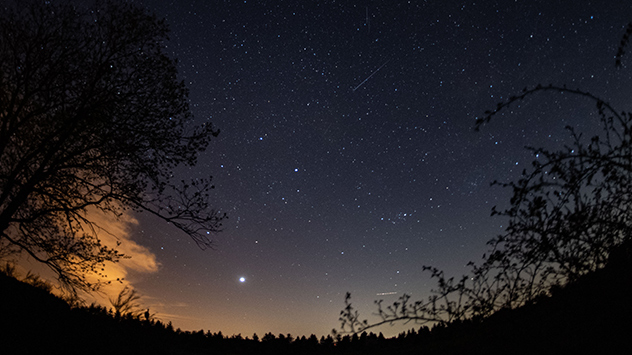
The Geminid meteor shower peaks

La lluvia de meteoritos Gemínidas alcanza su punto álgido entre el 13 y el 14 de diciembre

The countdown to 2026 is underway, but before the year ends we have the most active meteor shower of the year.

Sometimes nicknamed the "King of Meteor Showers," the Geminids peak late on the night of December 13th and last into the early morning hours. Capable of producing up to 120 meteors per hour at its peak, the shower itself offers a vibrant display of unusually bright shooting stars.

So, what will you see this year during the peak of what's considered one of the best astronomical events of the year? In a year with perfect visibility, more than 100 meteors per hour can be seen from a dark location. This year's peak is likely to produce only 30 to 40 visible meteors per hour, but since Geminid meteors are quite bright, it will still be a spectacular sight!

Learn about the astro cardread more

The Moon

December's Cold Moon, which occurred at the beginning of the month, was the third consecutive supermoon; one more remains in January, which will kick off 2026. And now, as we head toward a new moon, the Geminid meteor shower will be visible in all its glory... if the clouds cooperate. However, it will still be a spectacular sight, and unlike many other meteor showers, the Geminids can be seen throughout the entire night.

How to get the best view

Although the Geminids radiate from the constellation Gemini, they occur when the Earth passes through the debris field of asteroid 3200 Phaethon. 3200 Phaethon is the first asteroid to be associated with a meteor shower.

To enjoy the best view, it's ideal to find a dark location, far from city lights. The best way to see the meteors is to lie down with your feet pointing south. You'll also need to be patient. It will take about 30 minutes for your eyes to adapt to the darkness enough to see the meteors easily.

Mary Mays
More on the topic
Attention not translate yet!Tuesday, January 20, 2026

Amazing photos last night

Auroras still possible tonight
Small snowmen next to a weather map showing snow falling in parts of Scotland.
Saturday, January 17, 2026

When will snow fall?

Why forecasting snow is so tricky
Saturday, December 27, 2025

Icy beauty

The science behind rime ice
All weather news
This might also interest you
Winter storm
Friday, January 23, 2026

Havoc from TX to NE

Winter storm forming
Monday, January 26, 2026

Daily briefing

Frigid air mass settles in, storm wraps up
Nashville Ice
Tuesday, January 27, 2026

Day 3 without power

South recovers from ice slowly
All articles
Weather & Radar
US
Clima & Radar Brasil
Hava durumu & Radar Türkiye
Időjárás és Radar Magyarország
Καιρός & Ραντάρ Ελλάδα
Météo & Radar Belgique (Français)
Météo & Radar France
Meteo & Radar Italia
Meteo & Radar România
Météo & Radar Suisse (Français)
Meteo & Radars Latvija
OrasOnline Lietuva
Počasí & Radar Czechia
Počasie & Radar Slovensko
Pogoda & Radar Polska
Погода & Радар Україна (українська)
Tempo & Radar Portugal
Tiempo & Radar Argentina
Tiempo & Radar España
Vejr & Radar Danmark
Vreme & Radar Slovenija
Vreme & Radar Srbija
Vrijeme & Radar Bosna
Vrijeme & Radar Crna Gora
Vrijeme & Radar Hrvatska
Време & Радар България
Времето & Радар Macedonia
Weather & Radar India (English)
Weather & Radar Ireland
Weather & Radar United Kingdom
Weather & Radar USA (Español)
Weer & Radar België (Nederlands)
Weer & Radar Nederland

Weather & Radar is also available on

Google Play StoreApp Store

Company

Contact us Privacy policy Legal info Accessibility statement

Services

Uploader

Socials

instagramfacebookthreadslinkList