Home
Weather New York
WeatherRadar
RainRadar
TemperatureRadar
WindRadar
LightningRadar
Weather News
Editor's Pick
Discover the app
Weather widget
Contact us
Apps
Career
Home / Editor's Pick /

Late year features: 10 facts about fog

01:00 PM
November 8, 2025

Low clouds
10 facts about fog

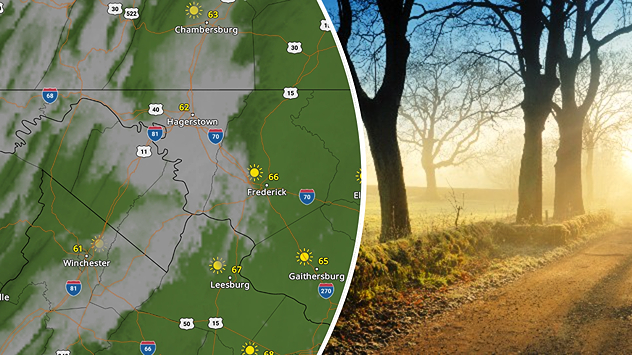
Fog impacting the Appalachian Mountains.Fog impacting the Appalachian Mountains.

Autumn is in full swing and so is the season of fog. Here are some facts, tips and rules of thumb about fog.

In autumn, high-pressure areas can provide not only a beautiful autumn sunrises and sunsets, but also stubborn fog in some places.

1. Fog forms on clear nights

Particularly in the late-autumn and early-winter months, the earth's surface cools down considerably on clear nights. The temperature drops until it reaches the dew point and condensation begins. The result: fog.

Clouds, on the other hand, act like a blanket and keep the heat on the ground. This inhibits the formation of fog.

Driving in fog safety tipsread more

2. Warmer on the tops of mountains than valley bottoms

On clear, calm nights conducive to the formation of fog, a temperature inversion takes place. The cold air subsides and drags down to the valleys, leaving the higher hill-tops and mountain-tops warmer. However, following normal physics in the troposphere, the lowest layer of the atmosphere, temperatures cool with altitude. Fog can then form in the valley bottoms, remaining stagnant until a breeze kicks it up and mixes the air around.

3. WeatherRadar shows fog

On the WeatherRadar it is easy to see which areas are affected by fog. If you are leaving for your early morning commute or perhaps a walk in the hills, you can ensure that the destination is outside or above the fog.

4. Shallow fog - quicker to shift

The shallower the cold air over a fog-filled layer is, the faster it can dissipate during the day. With a thicker layer of fog, a larger amount of the air must be heated until the fog disappears.

5. Ghostly phenomena

If sunlight falls on the water droplets of the fog, mysterious optical phenomena, such as Glories or Brocken Spectres can occur. How this works exactly, you can read in the weather lexicon.

In addition, in winter, fog and wind can create magical works of art called rime.

6. Wind kills fog

Wind can also dissolve the fog, or prevent its formation. A light wind is enough to kick up the cold surface air, and mix it with warmer air from above.

7. Fog over the water

The areas most often plagued by fog are in river valleys and on lake shores. Especially in autumn, a lot of moisture evaporates from the still, warm waters, conducive for the formation of fog.

On the coasts, a different process causes sea fog, especially in spring.

8. Forecasting fog is tricky

We've all experienced it at some point: although the sun was forecast, we were stuck in permanent grey all day. Fog forecasts are among the most difficult predictions. The weather models are often off the mark, especially when it comes to the time of dissipation. In general, the later in the fall, the greater the chance of it remaining stubborn all day.

9. Bad air quality in fog

Especially in winter, when there is a lot of heating, pollutants collect in the air near the ground. Because of the inversion, there is hardly any exchange and mixing of the air. Fine dust pollution then not only increases for us it also increases the formation of fog as water vapor condenses on the fine soot particles.

10. Fog photography

Autumn fog is among the most beautiful weather features to photograph. The perspective from mountains or hills on the sea of fog also makes for enchanting pictures.

James West
More on the topic
Winter weather impacts Minneapolis.
Saturday, January 3, 2026

Build your emergency kit

Stuck in a snow storm survival kit
teaser
Thursday, February 5, 2026

Winter's quick-hitters

What you need to know about snow squalls
Attention not translate yet!Tuesday, January 20, 2026

Amazing photos last night

Auroras still possible tonight
All weather news
This might also interest you
Wintry weather impacts D.C. on the WeatherRadar.
Sunday, February 1, 2026

Snow, sleet or ice

How atmospheric temps shape winter precipitation
Sunday, February 1, 2026

A quick overview

The cold air stays east, warm west, but another cold for the East
Saturday, February 7, 2026

Dangerous wind chills

Extreme cold hits East
All articles
Weather & Radar
US
Clima & Radar Brasil
Hava durumu & Radar Türkiye
Időjárás és Radar Magyarország
Καιρός & Ραντάρ Ελλάδα
Météo & Radar Belgique (Français)
Météo & Radar France
Meteo & Radar Italia
Meteo & Radar România
Météo & Radar Suisse (Français)
Meteo & Radars Latvija
OrasOnline Lietuva
Počasí & Radar Czechia
Počasie & Radar Slovensko
Pogoda & Radar Polska
Погода & Радар Україна (українська)
Tempo & Radar Portugal
Tiempo & Radar Argentina
Tiempo & Radar España
Vejr & Radar Danmark
Vreme & Radar Slovenija
Vreme & Radar Srbija
Vrijeme & Radar Bosna
Vrijeme & Radar Crna Gora
Vrijeme & Radar Hrvatska
Време & Радар България
Времето & Радар Macedonia
Weather & Radar India (English)
Weather & Radar Ireland
Weather & Radar United Kingdom
Weather & Radar USA (Español)
Weer & Radar België (Nederlands)
Weer & Radar Nederland

Weather & Radar is also available on

Google Play StoreApp Store

Company

Contact us Privacy policy Legal info Accessibility statement

Services

Uploader

Socials

instagramfacebookthreadslinkList